
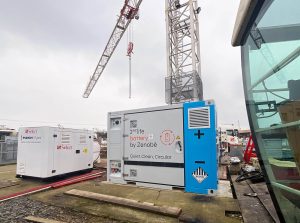
Select Tower Cranes in Birmingham
See how Zenobē’s mobile BESS powered four tower cranes for Select Plant Hire, slashing diesel use by 98% and cutting 284,000kg of CO₂.
Zenobē’s Portable Power team used commissioning experience and battery expertise to develop an alternative solution to traditional commissioning.
Commissioning Zenobē’s 600MWh Battery Energy Storage System (BESS) in Kilmarnock South was initiated with no grid connection. Instead, the Zenobē Portable Power team used Mobile BESS to execute a controlled energisation to manage inrush currents, and in turn, reduce the generator size requirements by up to 30 times.
The mobile BESS utilised second-life EV batteries, creating a closed-loop connection across Zenobē’s Network Infrastructure, EV Fleet and Portable Power businesses.
Traditionally the commissioning process starts once the grid connection is energised, but due to frequent delays this adds risk to project delivery timelines. Commissioning prior to grid with generators overcomes the issue of delayed timeline but results in high cost and carbon through inefficient generator usage. Using Mobile BESS alongside generators optimises the above solution with the savings stated.
If you’re at the stage of planning battery provision, get in touch and we’ll take a look together.
Using portable power to support the commissioning process in this way is the first of its kind for the industry. Not only did it lead to carbon emission savings against an industry benchmark, it also reduced equipment and power requirements, showing that clean, reliable, mobile energy is ready and available today.
Zenobē is the largest operator of transmission-connected batteries in Great Britain – read more about our Network Infrastructure division.


Due to the live nature of the environment, the requirements of the temporary power solution were continually changing, which presented many obstacles. A deft knowledge of batteries is required to monitor performance and react accordingly to any changes within the system.
The Portable Power team’s specialised knowledge in managing a hybrid mobile battery and generator system was paramount in managing the dynamic conditions effectively. Ongoing support and consultation meant the battery and generator system were managed throughout the commissioning period to ensure the most fuel efficient and reliable solution, whilst meeting project deadlines and beating budget expectations.
A mobile BESS unit can form an island grid when no grid connection is available. The system can be implemented with a generator in a hybrid system.
The generator is controlled by the battery and runs less than 1/3 of the time of a traditional method. Not only this, but it also only runs at efficient rates.
What are the applications?
Want to know more about batteries for your infrastructure project? Speak to our team today.
Commissioning a battery storage system involves energising the system and running tests on each part of the electronics and batteries to ensure that all equipment is working as anticipated. Following energisation, there must be stable island grid in place that can handle load step changes. This is usually managed with oversized generators and load banks. The inverters must then be switched on to begin pulling reactive power. This must be completed before a site can begin providing service.
Zenobē Portable Power used novel mobile BESS capabilities and supporting services to enable hot commissioning of a groundbreaking BESS project prior to the grid connection being energised.

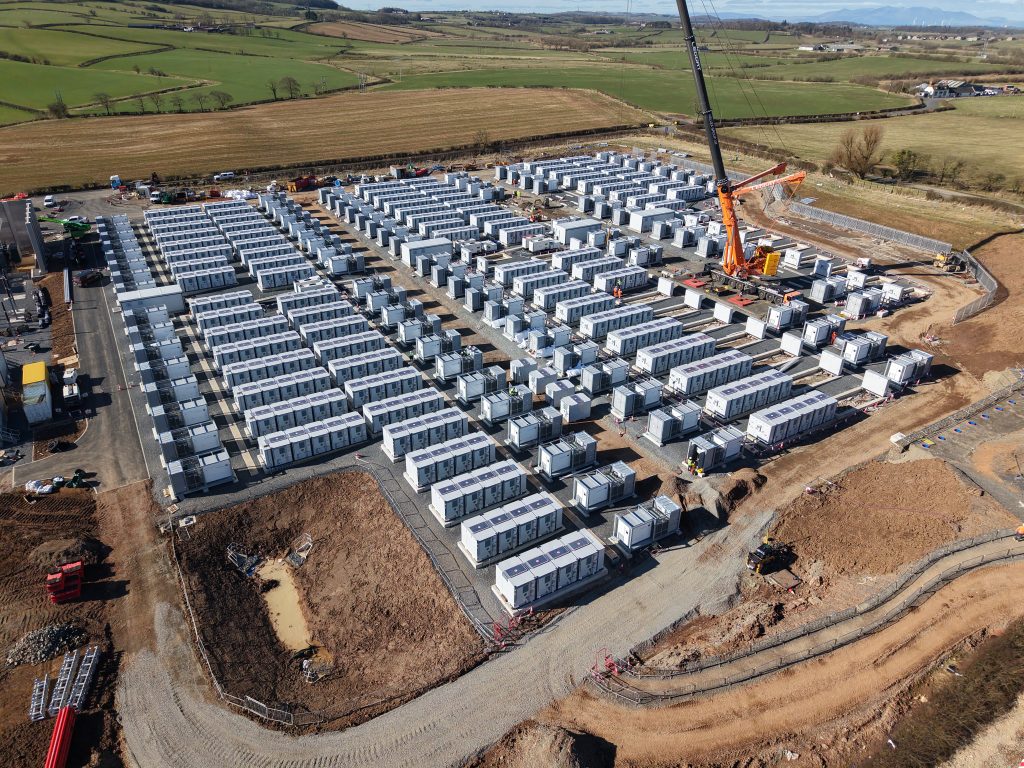
Traditional methods for commissioning involve having a large number of generators and load banks on the site to support the inrush currents of transformers. Replacing the majority of generator power with a mobile BESS is advantageous for several reasons, as it enables you to:
Transformers have two coils which have magnetic fields and an alternating current. This alternating current induces each coil with a different voltage. When the transformer is initially powered on, the coils magnetise and essentially click into place. As they click into place, a phase imbalance occurs that causes huge reactive power. This results in a big inrush of current, which traditionally requires big generators to support it.
With Zenobē’s proficiency in battery operations, a method was developed to use mobile batteries alongside generators. This leverages the control capabilities of inverter technology to to mitigate the inrush current.
During commissioning, a stable island grid is required that is capable of managing volatile loads. Generators and load banks are typically used to support this and are traditionally oversized.
By combining batteries with generators, the volatility of the load becomes manageable. The generator no longer needs to be oversized to compensate for large changes, and the load bank can be eliminated from the process. Batteries are more responsive to load changes than generators. Zenobē supplied the full power island including BESS, generation, and distribution as full solution provider.
Working in a live environment always presents unexpected challenges, and Kilmarnock was no different. The requirements of the temporary power solution were continually changing.
The Zenobē Portable Power team utilised its specialised knowledge in managing a mobile battery and generator system to effectively react to the dynamic conditions. Ongoing support and consultation ensured the system was updated throughout the commissioning period, to achieve the most fuel-efficient and reliable solution.
The team’s fast thinking ensured that the project met delivery deadlines.


6 weeks’ commissioning time saved

260,000L of fuel saved

The total cost for the portable power solution in Kilmarnock was 28% lower than the benchmark solution. These financial savings are enhanced by fuel savings of 260,000 litres and carbon emission savings of 707 tCO2 – a significant figure for this part of the process.
To measure the benchmark for cost savings, we gathered detailed estimates for an energisation using diesel generators, allowing a side-by-side comparison. The fuel consumption for the estimates formed our benchmark. The battery techniques used to create this innovative solution is a collaboration between the Portable Power team and the Network Infrastructure team at Zenobē. The technology and techniques that are being used by Network Infrastructure are a foundation for Portable Power to provide these new, sophisticated services


Andrew Winter, Senior Site Construction Manager in Delivery UK, was also pleased with the work between the teams, and anticipates future collaborations. “Portable Power arranged a setup to do a set test rig. It was well organised, and similarly, when there were changes to be made it has to be quite reactive and the Portable Power team were good at addressing that quickly.”
Indeed, both contractor and client teams used a test-and-learn approach, finding new ways of working that supported this groundbreaking new technology.
Tasked with ensuring projects deliver maximum positive environmental impact, Andrew saw the value in using the emission-free option, while also securing a cost saving.
The Kilmarnock delivery team welcomed the new technology and adapted their methods to enable the decarbonisation of the commissioning process.
commissioning time saved
tonnes of CO₂ emissions prevented
of fuel saved
Talk to our experts about battery powered solutions. Let’s explore the options, so you can see power saving models first-hand.
See how Zenobē’s mobile BESS powered four tower cranes for Select Plant Hire, slashing diesel use by 98% and cutting 284,000kg of CO₂.

Discover how portable power helps a vast construction site with limited grid access to reduce its carbon footprint.
Discover how mobile BESS was deployed together with power management, to help Falcon Cranes reach new heights in its carbon-cutting ambitions.
*To measure the benchmark for cost savings, we entered discussions with two generator suppliers and provided them with the required data. A solution was provided using traditional methods gathered detailed estimates for an energisation using diesel generators, whereby we calculated the fuel consumption and used it as a benchmark allowing a side-by-side comparison. The fuel consumption for the estimates formed our benchmark.
Thanks for getting in touch – we’ll respond as soon as possible. You can also reach us on contact@zenobe.com

Pete leads Zenobē’s growing team of Product specialists across all areas of the business. His team oversee our R&D as well as product development in both hardware and software.
He has been working in the European E-Mobility sector from over ten years, specialising in the design, build and delivery of software systems for EV Charging.