

Fleet electrification across Canada remains an important initiative in many jurisdictions, driven by its tangible benefits and the support of government funding. However, recent shifts in policy and funding priorities create challenges that threaten to decelerate this transition. As a result, fleet operators and transit agencies face a disconnect between the urgency of their decarbonization goals and the financial tools available to achieve them.
The higher up-front costs of electric vehicles and their associated infrastructure remain a hurdle. Zenobe’s fleet strategies can allow lifetime Total Cost of Ownership of electric fleets to approach parity with diesel-powered counterparts. Traditional lenders are hesitant to underwrite electric fleets due to those higher initial costs and perceived limited residual value, although the supporting data pool is growing with each passing day.
Federal, provincial, local and utility programs offer partial support, yet many projects stall when funding falls short, or timelines stretch. But funding need not be a hurdle – it can instead be an opportunity to unlock the long-term value of your electric fleet. Zenobe is working with several transit and bus operators in Canada to bring these opportunities here.
Backed by KKR and M&G Infracapital, as well as other major investors and lenders, Zenobē takes the role of capital provider to operators to keep fleet electrification projects moving, even when grant funding is delayed, reduced or unavailable. Our funding support includes electric fleet financing for vehicles, infrastructure and batteries in Canada and worldwide, creating an approach that responds to the cost realities of electrification today and closes the capitalization or “cap” gap – the difference between the funding secured, and that needed.
By successfully deploying retired electric vehicle batteries as second-life storage systems at music festivals, worksites and on film sets, we can take a view on battery residual value. This turns batteries from liabilities into assets. By factoring these savings into the initial planning stages, we help reduce the total cost of ownership (TCO) make fleet electrification more affordable.
A recent example is our CA$48 million financing for Canadian electrification provider 7Gen. The funding we provided lets 7Gen finance and deploy between 400 to 500 new electric trucks and buses bundled with charging solutions, while the company can refinance a portion of its current fleet. It’s a case that underscores our unique ability to deliver capital to electrification efforts and support deployment at scale when traditional funding avenues fall short.
It’s the type of experience Zenobe brings to our work with customers in Canada. But it’s not just the funding that needs to be considered – we’re bringing design and planning, software, supply chain and capital markets expertise from our team to ensure their electrification plans are based on experience, not just spending.

Before funding needs can be properly assessed, successful fleet electrification projects need to be accurately planned. Supporting more than 3,400 electric vehicles across 122 depots globally, our team has amassed the experience needed to help forward-looking operators and agencies plan, finance and advance their fleet electrification projects.
We know operators need highly accurate assessments to inform their plans like vehicle type(s), charging needs, possible infrastructure constraints, future-proofing needs and more. Misjudging or overestimating any of these factors can significantly inflate costs and unnecessarily complicate projects. While careful planning helps optimize project scope and reduce unnecessary expenditures, making projects even more viable and ultimately, sustainable.
After careful planning, you’re ready to look at financing needs and explore the best mix of public incentives, utility programs and private capital for your unique situation. Our role is to support this electrification journey rather than let funding limitations shape it.
An example of this strategy is Zenobē’s support for Oxford Bus Company. Zenobē provided roughly $24 million in funding to enable the launch of 104 electric buses as part of a broader $111 million project that included both public and private investment. We financed the batteries and charging infrastructure using our battery-as-a-service (BaaS) model, ensuring operational readiness while reducing capital pressure on the operator. Frequently, as in this case, the electric fleet financing complements public funding to accelerate zero-emission transport at scale.
The Battery-as-a-Service (BaaS) approach mentioned above, as well as the Electric Vehicle-as-a-Service (EVaaS) path can significantly help advance electrification projects by injecting flexibility for fleet operators, creating new ways to manage costs and reduce financial uncertainty.
Battery-as-a-Service (BaaS) allows operators to lease, rather than purchase outright, the battery portion of their electric vehicles, which can account for up to half of a vehicle’s cost. Instead of making a large upfront investment, operators can pay a predictable monthly fee that includes battery monitoring, performance guarantees, and replacement if the battery underperforms. This model not only simplifies budgeting but also offloads the technical and financial risk to us, Zenobē.
Our partnership with Nottingham City Transport followed this model. We financed the batteries on board 24 new electric buses, and gave a 16-year performance guarantee. We also supplied and continue to manage the depot’s charging infrastructure. This arrangement lets Nottingham operate a zero-emission fleet without the financial burden or operational risk of battery ownership (that we’ve taken on), while ensuring service reliability and cost predictability over time.
Electric Vehicle-as-a-Service (EVaaS) goes a step further by letting you bundle it all–the vehicle and battery, charging infrastructure and supporting services, including the software and ongoing maintenance–into a single package that we manage for you. This end-to-end model lets you electrify a fleet without having to become an energy expert. You stand to benefit from all that goes with running a zero-emission fleet, while we take on the heavy lifting of procurement and integration. Your operations team remains in control of fleet performance, supported by our tools, training, and ongoing technical expertise as needed. And we’ll teach you and your team as much of the process as you’d like, but that’s entirely optional.
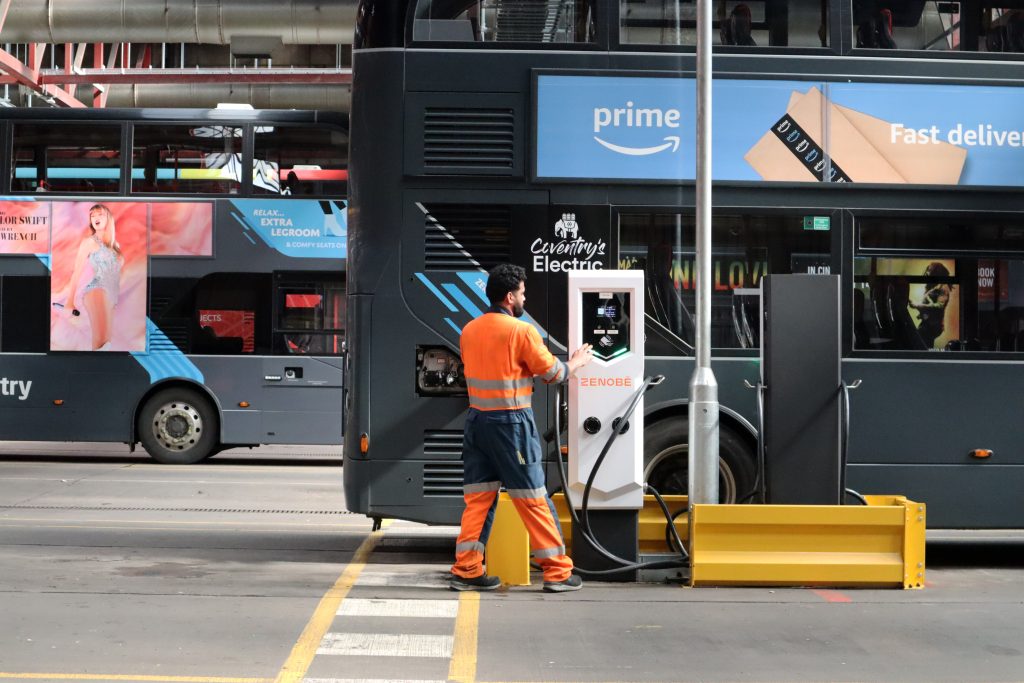
As part of a landmark deal to deliver 130 new electric buses to National Express (part of Mobico Group) in Coventry, UK, we delivered an end-to-end EVaaS solution that included financing, batteries, charging infrastructure, and operational software. This enabled National Express to electrify a significant portion of their fleet with minimal upfront capital outlay, while benefiting from our long-term performance guarantees and ongoing support.
Both of these approaches provide battery lifecycle management and help maximize value while reducing long-term cost of ownership. They remove uncertainty and make scaling predictable.
Despite ever-changing policies, the fundamentals of fleet electrification remain strong. Electric fleets offer lower long-term operating costs and reduce exposure to fuel price volatility — reasons adoption continues with agencies and operators in Canada and around the world.
And the benefits go beyond cost savings. Electric fleets mean cleaner air, quieter streets and smoother rides for drivers and passengers alike. Transit and delivery fleets see improved working conditions and community perception. School buses create healthier environments for children. The list goes on.
More than anything else in Canada, electrification remains a strategic decision with clear business benefits. With the right planning, partners and financing, fleets can both go electric… and help all to get ahead.
Learn more about our capabilities here. For advice or support with your electric fleet project, connect with our Zenobē North America team via John Kardos, VP – Business Development – Canada at john.kardos@zenobe.com

Pete leads Zenobē’s growing team of Product specialists across all areas of the business. His team oversee our R&D as well as product development in both hardware and software.
He has been working in the European E-Mobility sector from over ten years, specialising in the design, build and delivery of software systems for EV Charging.