
By Luke Green, Policy Analyst UK | 3-minute read
For transport authorities across the UK, improving air quality while maintaining reliable and affordable bus services can often feel like competing priorities. Electrifying fleets at scale has often been seen as complex, costly and hard to deliver beyond major cities.
But the urgency is growing. Recent analysis reported by The Times suggests that almost four times as many areas in England may be breaching legal limits for nitrogen dioxide as official government figures indicate, meaning millions more people could be breathing unhealthy air than previously acknowledged.
Things are changing though. London has shown what air quality improvements can be achieved when governance, policy and fleet standards are aligned. Oxford has shown that large-scale bus electrification can also be delivered outside the capital when local leadership, public funding, operator commitment and private finance come together.
With the Bus Services Act giving local leaders greater control over networks, fares, service standards and vehicle requirements, the opportunity is now clear: cities and regions implementing bus franchising can use these powers to accelerate bus electrification and deliver cleaner air faster.
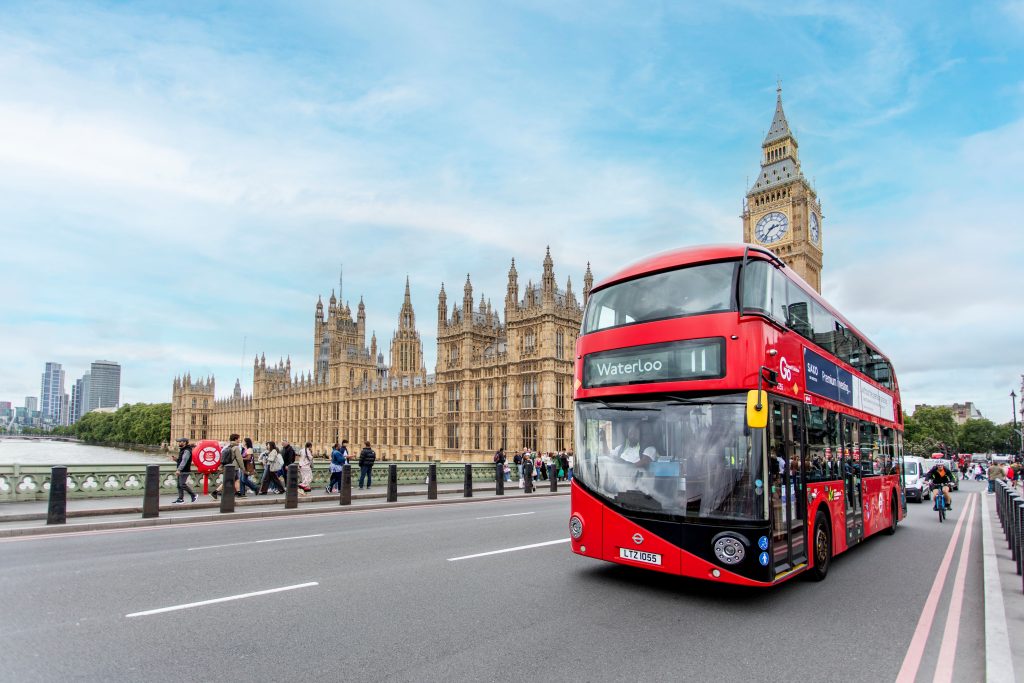
London’s progress has been enabled by a centrally franchised bus model. Since the 1980s, Transport for London has specified routes, service standards and vehicle requirements, allowing the capital to take a coordinated approach to fleet renewal and emissions reduction.
That structure has supported the rollout of one of Europe’s largest zero-emission bus fleets – London now has 3,000 electric buses across over 100 fully-electric routes – and has helped deliver measurable air quality benefits.
The impact has been significant:
While London’s model is centrally coordinated, delivery has still depended on operator investment and private sector infrastructure expertise – showing that public control and private finance can work together, alongside skilled delivery partners, to achieve ambitious transitions.
Outside of the capital, the pace of electrification in the UK can feel fragmented. This has not been driven by a lack of desire to implement new technology – the challenge has been structural.
Since deregulation in 1986, bus services outside the capital have been more fragmented, with decisions on routes, fares, service standards and fleet renewal shaped more by commercial priorities and less by central coordination. That has made it harder to deliver large-scale, network-wide transformation.
Clean air policies have also been implemented unevenly outside London, with schemes often introduced at smaller scale and facing political resistance. In many cases, public debate has focused on short-term cost rather than the long-term health, environmental and service benefits.
The Bus Services Act changes the context. By giving the country’s local transport authorities greater powers to franchise bus services or establish municipal bus companies, it creates an opportunity for local leaders to take a more coordinated approach to network planning, fleet requirements and air quality initiatives.
Oxford shows that large-scale bus electrification is not only possible in London.
In 2023, Oxford launched one of the UK’s most ambitious electric bus projects outside the capital, delivering charging infrastructure for 159 electric buses across Oxford Bus Company and Stagecoach. The scheme brought together ZEBRA funding, council support, operator investment and private infrastructure finance.
The results have been clear:
Zenobē supported the project by delivering the charging infrastructure needed to make the transition operationally reliable. But Oxford’s success was not driven by technology alone. It was enabled by strong political leadership, a clear local transport strategy and effective collaboration between public authorities, operators and electrification delivery experts.

Public funding has helped accelerate the first wave of bus electrification, but long-term progress cannot rely on grant funding alone.
Private finance and as-a-service models can help local authorities and operators overcome some of the biggest barriers to fleet transition. They can reduce upfront capital costs, support the delivery of charging infrastructure and help manage risks linked to battery performance, depot upgrades and long-term operations.
This matters because the opportunity created by the Bus Services Act is not only about governance. It is about delivery. Local leaders may now have greater powers to shape networks by implementing bus franchising, but they will still need commercially viable models to turn ambition into operational electric fleets.
By combining public funding, operator insight, private capital, and electrification expertise, authorities can make available funding go further and accelerate clean air benefits for communities.
The question is no longer whether change is possible, but whether local leaders will use the powers now available to them to deliver it.
London has shown what coordinated governance can achieve at scale. Oxford has shown that, with the right partnerships, that progress can be replicated outside the capital. The Bus Services Act now gives local leaders the tools to move faster, while private finance and delivery partnerships can help turn plans into working electric fleets.
For cities and regions looking to improve air quality, reduce emissions and modernise public transport, the route is becoming clearer. Electric buses are proven, deliverable and ready to scale.
Thanks for getting in touch – we’ll respond as soon as possible. You can also reach us on contact@zenobe.com

Pete leads Zenobē’s growing team of Product specialists across all areas of the business. His team oversee our R&D as well as product development in both hardware and software.
He has been working in the European E-Mobility sector from over ten years, specialising in the design, build and delivery of software systems for EV Charging.