
The nature of batteries is that they degrade over time and use. The charging and discharging of a battery initiates a chemical process that causes physical changes to the battery and reduces the total amount of energy the battery can store. A new battery will have a 100% maximum energy capacity – this percentage is known as the state of health of the battery.
It’s generally agreed that battery replacement is typically required at around 70% state of health (SoH), though this will depend on the fleet vehicle type, and its utilization. From this point, degradation accelerates – this stage is often known as the “knee point”. This is a normal and predictable part of fleet lifecycle management. Much like a diesel engine or chassis replacement, EV battery replacement should be planned into your long-term operating model.
You can find more information about battery degradation in our explainer here.
Identifying the right time for EV battery replacement is crucial to maintaining performance and avoiding unplanned downtime. At Zenobē, through our Battery as a Service contract, vehicles are equipped with telematics devices as standard. These devices continuously transmit key battery performance data such as power output and voltage back to our monitoring systems. This data is analyzed using an externally validated algorithm to determine the battery’s current state of health and forecast future degradation.
Our team aims to identify the replacement around six months in advance, allowing time for the battery replacement to be booked in alongside other fleet and depot maintenance, to minimize downtime of the vehicle and any potential impact to your fleet operations. The cost of the new battery and the replacement process is covered under the cost of a Battery-as-a-Service contract.
Replacing an electric vehicle battery is far from a simple swap. It’s a highly coordinated process that brings together multiple specialist teams.
Each stage must be carefully planned and executed to minimize downtime and ensure safety, performance and compliance. We remove this complexity entirely by booking, planning and managing the whole process on your behalf, so you can stay focused on operating your fleet.
To get a vehicle ready for battery replacement, we bring together skilled people from battery procurement, technical integration, customer experience and project management.
Together, these teams
The replacement process usually takes between 12 and 15 hours of work per vehicle, comparable to traditional maintenance downtime.
It’s a complex and highly technical job, meaning specialist engineers using heavy equipment are required. For this reason, we usually arrange for the replacement to take place offsite, via the OEM or on a third-party facility.
Step 1 – Preparation
Once the vehicle is at the battery replacement facility, specialist engineers assess the vehicle, following strict health and safety procedures throughout the process. They:

Once the engineers are satisfied that the vehicle is safe, the removal and replacement process can begin.
In the case of a bus, the battery is made up of multiple packs that are located throughout the vehicle, including in paneling on the side and under the floor. Similarly with an electric truck, the batteries are usually located within the main frame rail of the vehicle.
The engineers carefully disconnect the battery packs from their mechanical and electrical connections. The new battery packs are then installed into the vehicle, requiring meticulous and skilled reconnection of low voltage and communication cabling.
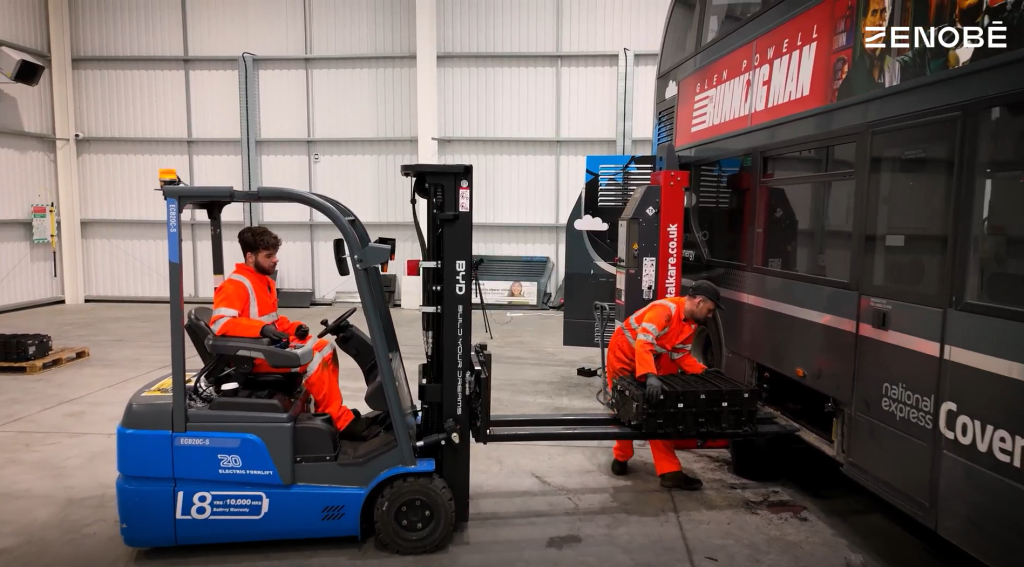
Once the new battery is in place the vehicle is rebalanced and the cooling system is refilled and purged of airlocks. The battery is then tested by completing a full charge and discharge to check the renewed state of health. The engineers then undertake a final system commissioning to ensure the battery is connected and operational.
The vehicle is now ready for service with restored performance. Through the battery-as-a-service model, continuous monitoring resumes as soon as the vehicles are back on the road, giving operators confidence in their vehicle’s ongoing operations.
Whilst understanding battery health may feel technical and complex, the benefits are simple to understand:
A battery-as-a-service contract gives operators access to proven battery expertise and performance certainty, all for a predictable monthly fee. Zenobē handles the technical complexity while operators can focus on their core business.
Thanks for getting in touch – we’ll respond as soon as possible. You can also reach us on contact@zenobe.com

Pete leads Zenobē’s growing team of Product specialists across all areas of the business. His team oversee our R&D as well as product development in both hardware and software.
He has been working in the European E-Mobility sector from over ten years, specialising in the design, build and delivery of software systems for EV Charging.