
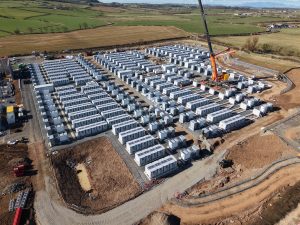
Kilmarnock South Commissioning
Discover how Zenobē’s Portable Power team used commissioning experience and battery expertise to develop an alternative solution to traditional commissioning.
Tower cranes require large amounts of power to carry out their tasks. Yet, as crane movements are only occasional, adopting a traditional power source is clearly an inefficient choice. A fuel-powered generator required has to be large – and is therefore wasteful from the outset.
Falcon Cranes wished to improve their fuel efficiency as well as minimise emissions, as part of their sustainability commitments. The construction industry is under pressure to reduce its environmental impact, and Falcon wanted to explore solutions to help its clients achieve better results.
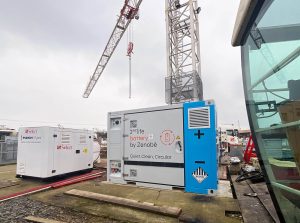
By working with Zenobē, Falcon Cranes uncovered the dual benefits of mobile BESS: cutting overall energy costs and reducing onsite pollution. The programmable battery unit enabled smarter power management and cleaner operations.
A 100 kW second-life mobile BESS (Battery Energy Storage System) was deployed alongside a 63A grid supply. This configuration powered a crane that would otherwise have required a 250 kVA generator.
Over a ten-week period, the BESS system saved Falcon Cranes an estimated £16,000* in diesel, by providing power only when it was needed. This result was for a crane that was active for 26% of working hours.
The CO2 that was avoided by not using a fossil fuel generator at site was 29,000kg. Looking at alternative fuels, the projected HVO cost avoided for this period was £26,500.
The cost for electricity to run the crane for the ten-week period was £1,540. This meant an overall fuel saving, from avoiding diesel, of £14,500. Extrapolating over a year returns fuel savings of £80,000.
* Diesel cost was assumed to be £1.5/litre and HVO cost of £2.3/litre. Calculations assume an electricity cost of £0.23/kWh.
Batteries store energy when it’s available, and release it on demand. This is an important function when there’s limited supply. For many organisations, it’s paramount that operations continue unimpeded.
On one occasion during the ten-week period, the grid connection at site was not available. Due to the features of the mobile BESS unit, the site operations were not disrupted. The crane could be powered for the day, though the grid supply was offline.
Want to know how much you could save? Zenobē uses its experience with power management to create optimised power plans for clients. Let’s explore the options, so you can see power saving models first-hand.
Talk to our team and learn more about clean power solutions.
Discover how Zenobē’s Portable Power team used commissioning experience and battery expertise to develop an alternative solution to traditional commissioning.
See how Zenobē’s mobile BESS powered four tower cranes for Select Plant Hire, slashing diesel use by 98% and cutting 284,000kg of CO₂.

Discover how portable power helps a vast construction site with limited grid access to reduce its carbon footprint.
Thanks for getting in touch – we’ll respond as soon as possible. You can also reach us on contact@zenobe.com

Pete leads Zenobē’s growing team of Product specialists across all areas of the business. His team oversee our R&D as well as product development in both hardware and software.
He has been working in the European E-Mobility sector from over ten years, specialising in the design, build and delivery of software systems for EV Charging.