
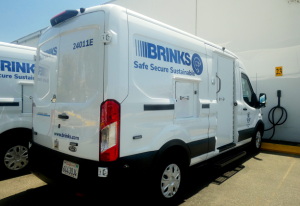
From self-delivery to expert-led scale
After a self-delivered 6-vehicle pilot, Brinks partnered with Zenobē to scale to 25 vehicles in 12 months, cutting costs and timelines whilst projecting $800k in fuel and maintenance savings.


70
vehicles supported
82
chargers installed in a decentralised setup
24/7
service support
As Zenobē continues to grow, its expansion across Europe becomes more pronounced. Part of this growth includes developing a deep understanding of the distinct ways operators work across the continent.
Zenobē has partnered with two Belgian bus operators, Coach Partners and Multiobus, supporting them through the electrification of their fleets — listening closely to their specific requirements and adapting its approach accordingly.


Coach Partners and Multiobus are both partners of De Lijn, the state-owned enterprise that provides scheduled bus and tram services across Flanders. Having started their journey with Zenobē a year apart, the two operators sat at different stages of electrification and had different requirements. Coach Partners needed support electrifying its public transit buses across Lede, Kortrijk, Roeselare and Maldegem, with a goal of reaching 100% electric operation in the years ahead. Multiobus needed support across the East Brabant region and further out into Tienen and Wijgmaal, with sustainability at the core of its business philosophy.
Both operators, as De Lijn subcontractors, receive a fixed allowance to cover the electricity cost of charging their fleets meaning that any efficiency gained in charging goes straight to the operator’s bottom line. Delivering charging infrastructure and software that could actually improve on that allowance, rather than simply meet it, was central to the brief.
Zenobē designed and delivered charging infrastructure tailored to each operator’s fleet and sites, and adapted its smart charging software to the Belgian market and the specifics of the De Lijn contract framework.
At Coach Partners, the first site launched in September 2024. Zenobē now supports 35 MAN public transport buses via 50 Kempower chargers, installed in a decentralised setup, a central CPU unit serving up to 8 guns each, giving a more resilient charging solution if an individual charger runs into issues. Two of Coach Partners’ sites also include solar power, opening up potential for further optimised EV charging in future.
At Multiobus, Zenobē launched a first site in September 2025 and a second in December 2025. The rollout supports 34 electric buses through 32 Kempower chargers, again in a decentralised setup with central CPU units.
Zenobē’s smart charging infrastructure automatically shifts charging to off-peak periods wherever possible. Within the framework of the De Lijn contract, this maximises each operator’s profit margin — if they charge their fleet for less than the rate De Lijn assumes, the difference adds directly to their margin. More bus depots are expected to electrify to stay competitive within new concessions, and Zenobē plans to roll smart charging out across all of its Belgian depots.
Zenobē acts as an all-in-one service provider, supporting operators from financing through to ongoing maintenance and management, 24/7. Its experience across a wide catalogue of bus and charger OEMs means it can compare sites and recommend the most appropriate solution case by case. Both Coach Partners and Multiobus have drawn on this ongoing local support, from software issues to supplier contract queries.
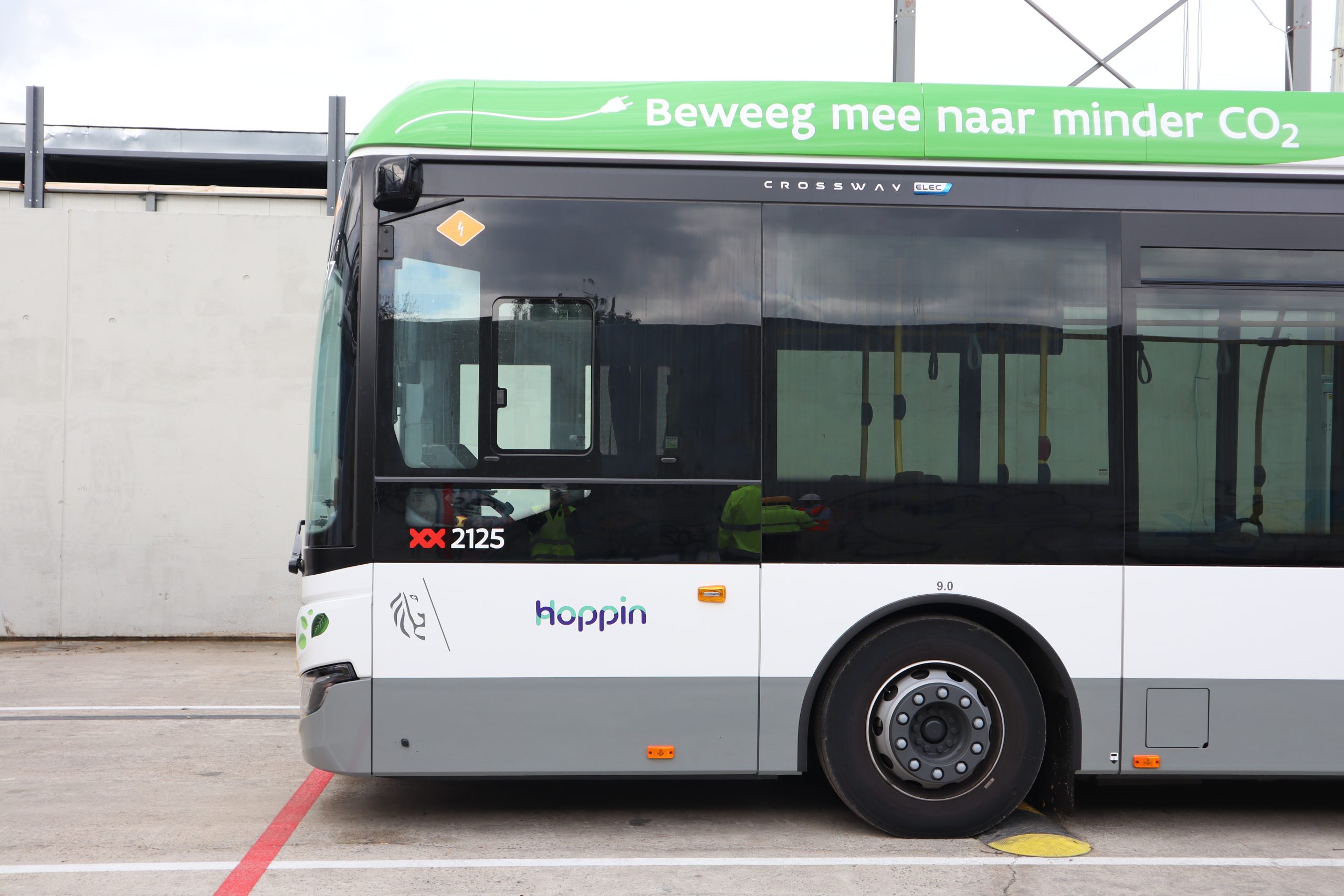
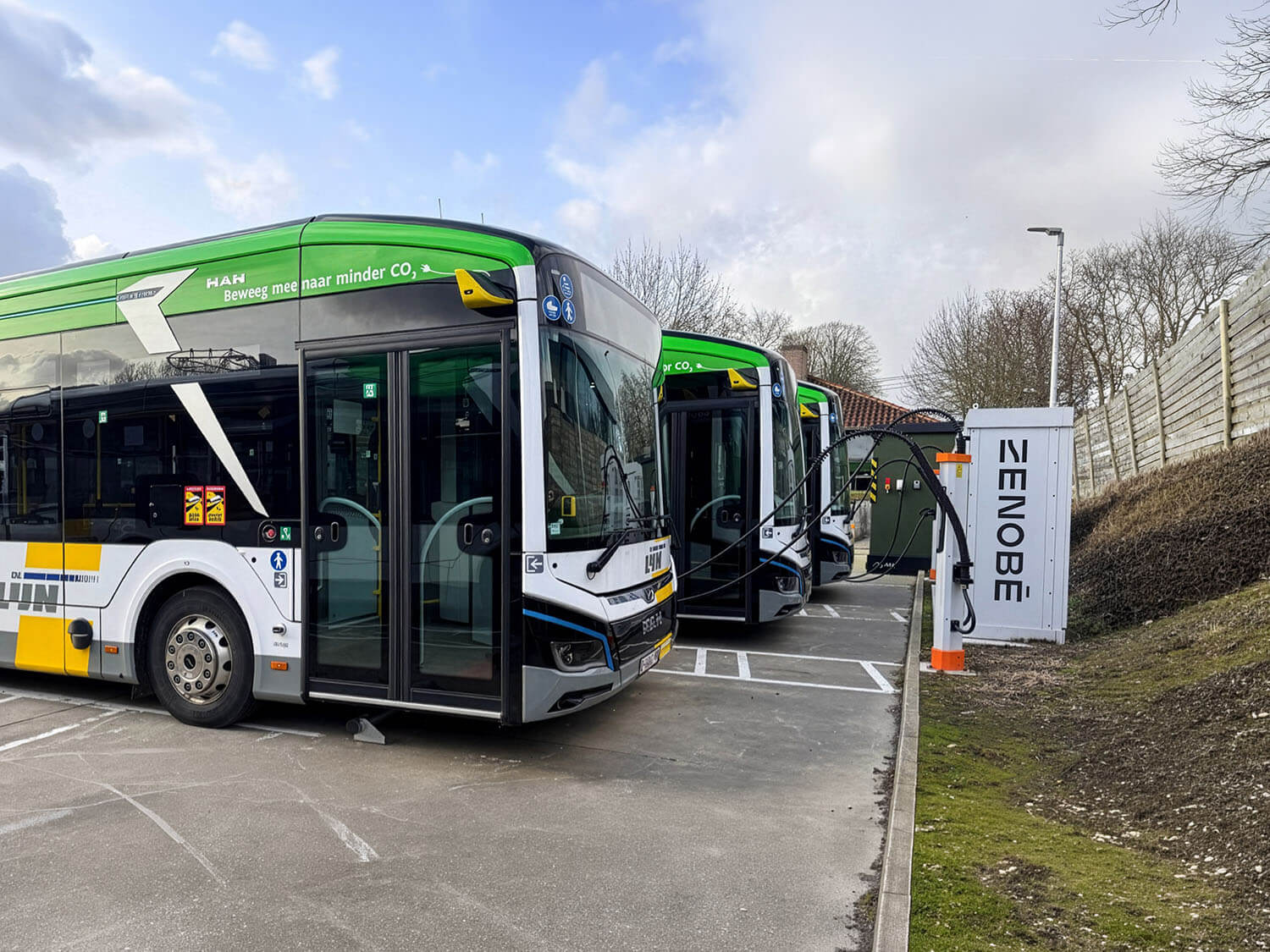
Zenobē now supports nearly 70 electric buses in Belgium; its first vehicles supported in the country, and a foundation for further growth in the region.
By automatically shifting charging to off-peak periods, Zenobē’s smart charging software helps operators consistently beat the De Lijn electricity allowance, directly increasing their profit margin.
Having proven its software’s compatibility with Belgian charger and bus OEMs, Zenobē is now ready to bring the same approach to the wider Benelux region.
Zenobē is keen to keep building on its partnerships with Coach Partners and Multiobus as much as forming new ones. Coach Partners is currently 40% electric across its operating areas, with plans to reach full electrification and eventually run with no diesel fallback at all. Its two solar-equipped sites offer a clear next step for optimisation. Multiobus’s battery storage site presents a similar opportunity. Now that Zenobē’s software is integrated with the location-specific charger and bus OEMs, the next phase of work is optimising the assets already on the ground.
Having supported 70 buses in Belgium, Zenobē is proud to be building new relationships with Belgian operators, and looks forward to continuing to support the country’s bus operators through electrification.
After a self-delivered 6-vehicle pilot, Brinks partnered with Zenobē to scale to 25 vehicles in 12 months, cutting costs and timelines whilst projecting $800k in fuel and maintenance savings.
Zenobē partnered with Educational Bus Transportation (EBT), a managed entity of The Trans Group, to finance 10 electric school buses and deliver the associated charging infrastructure for Copiague Public Schools. The project supports New York State’s school bus electrification goals while providing zero-emission transport for approximately 4,500 students and creating a scalable foundation for future fleet expansion.
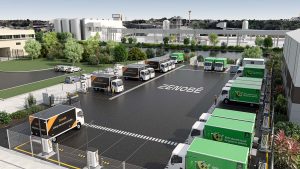
Find out how Zenobē’s latest project has catalysed electric vehicle charging in Mascot, Sydney, not only for a grocery brand but also businesses in the logistics and fleet industries.
Thanks for getting in touch – we’ll respond as soon as possible. You can also reach us on contact@zenobe.com

Pete leads Zenobē’s growing team of Product specialists across all areas of the business. His team oversee our R&D as well as product development in both hardware and software.
He has been working in the European E-Mobility sector from over ten years, specialising in the design, build and delivery of software systems for EV Charging.